

Indoor signs

9/29/2026
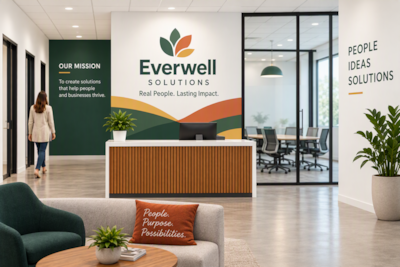
An office does more than provide a place to work. It reflects an organization’s identity and shapes the experiences of employees and visitors.
When organizations think about branding, they often focus on marketing materials, websites and exterior building signage. Yet employees spend far more time interacting with their physical workplace. Office design influences how easily people navigate the space, how effectively different areas support workflow and how connected employees feel to the organization.
The opportunity is significant. According to Gallup, only 20% of U.S. employees strongly agree that they feel connected to their organization’s culture. Employees who do feel strongly connected are 4.3 times as likely to be engaged at work.
While workplace branding cannot create culture on its own, it can reinforce an organization's values, identity and sense of purpose. Office signs and graphics, environmental graphics, interior branding and color can communicate what an organization stands for while supporting the practical ways people use the space.
Most organizations can articulate their mission, vision and values. But are those messages visible throughout the workplace?
Interior branding turns organizational messages into visible parts of the employee experience. Instead of limiting a mission or set of values to a website, presentation or employee handbook, organizations can incorporate those messages into the spaces employees use every day.
These can be used to:
These are more than decorative features. They can help employees connect with the organization and create a stronger sense of purpose. Gallup found that employees with a strong sense of purpose at work were 5.6 times as likely to be engaged.
That does not mean putting a mission statement on a wall will automatically improve engagement. However, mission statement wall graphics, recognition displays and company history graphics help keep key messages visible. They also connect the workplace to the company’s overall vision.
Creative signage designs go beyond generic values. They can show how employees help customers, celebrate community partnerships or recognize achievements. These details make the workplace more meaningful and uniquely connected to the organization.
Not every area of an office serves the same purpose. Focus spaces, collaboration areas, conference rooms and offices are designed for different types of work.
This matters because many workplaces still aren't set up to support everything employees need to do during the day. Gensler's 2025 Global Workplace Survey gathered input from more than 16,000 office workers across 15 countries and 10 industries. Only 26% of respondents strongly agreed that their workplace helps them do their best work.
Before choosing graphics, colors or signage, start by thinking about how each space is used.
Questions such as these can help guide the planning process:
A focus area may benefit from a cleaner, less distracting environment, while collaboration spaces often have more room for color, creative graphics and storytelling. Reception areas are often the first place visitors connect with a brand, and common spaces can be used to celebrate employees, share company news or reinforce company values.
The goal isn't to cover every wall. The goal isn't to fill every blank wall. It's to make sure each sign, graphic and branded element serves a purpose while contributing to a workplace that feels thoughtfully designed.
The reception area often provides the first interaction customers, job candidates, vendors and community partners have with an organization’s brand. A lobby can quickly communicate who the company is and help visitors feel confident they have arrived in the right place.
Custom lobby signs provide a clear visual focal point and establish the brand from the moment someone enters. Options include:
The best choice depends on the organization’s brand, architecture and desired visitor experience. A technology company may prefer illuminated dimensional lettering and a modern feature wall. A professional services firm may choose understated metal letters paired with different finishes. A community organization may use local photography and mission-focused messaging to make the reception area feel more personal.
Lobby branding should match the look and feel of the rest of the workplace. Carrying related colors, materials or graphic elements into conference rooms, corridors and common areas can create continuity without making every space look the same.
Walls provide valuable opportunities to communicate culture, history and purpose. Custom wall graphics and wall murals can turn underused surfaces into visual experiences that are specific to the organization.
A large wall mural may show local landmarks, branded art or images of customers and communities the organization serves. A hallway can become a company history timeline. A break room might recognize employee contributions, while a training area can display key principles or educational messages.
Dimensional lettering can add depth to company names, department identifiers, values or short statements. Because the letters project from the wall, they create a more appealing presentation than flat graphics alone. You can also combine dimensional elements with printed backgrounds or wall graphics to create a layered design.
Glass surfaces create additional branding opportunities. Window graphics can add visual interest to exterior or interior glass while reinforcing the brand. They may include logos, patterns, campaign messaging or decorative elements that complement the surrounding office design.
Graphics should support the space rather than compete with it. A few focal points will generally communicate more effectively than placing large messages on every available surface.
Glass walls can help offices feel open and allow natural light to reach interior spaces, but they may not provide enough privacy for meetings, private conversations or focused work.
Custom privacy films add separation without major structural changes. Organizations can apply frosted films, patterned films and branded designs to conference rooms, private offices and glass partitions. Depending on the design, the film can obscure sightlines while still allowing light to move through the space.
Privacy films can also contribute to the broader interior branding strategy. Brand colors, geometric patterns or subtle logo elements can help glass surfaces coordinate with nearby wall graphics, lobby signs and conference room graphics.
Clear glass panels may also be difficult for some people to notice. When appropriate, decorative bands or patterns can make glass surfaces more visible while supporting the space's design. Any graphics used to communicate necessary information should not rely on color alone, since words, icons and other visual cues can provide greater clarity.
Give Conference Rooms a Clear Purpose
Conference rooms support client meetings, employee conversations, training and collaboration. Their graphics should enhance the space without distracting from the activity taking place.
Conference room graphics often incorporate:
Conference room graphics can do more than identify meeting spaces. Organizations often use room names to reinforce company values, celebrate local connections or highlight significant milestones. Coordinated room signs help employees and visitors identify each space easily while contributing to a more consistent workplace experience.
For glass-enclosed meeting rooms, branded privacy film can provide a practical layer of discretion. For solid walls, photos, raised letters or simple wall graphics can add interest. They also keep the room right for talks and discussion.
The goal is not to make every meeting room a marketing display. It is to give each space a clear identity that fits within the larger branded environment.
A productive workplace is one where employees and visitors can move from one area to another with confidence. Confusing corridors, inconsistent room names and missing directional signs can lead to delays and unnecessary interruptions.
Office wayfinding is particularly important in larger workplaces, multi-tenant buildings, healthcare environments, educational campuses and facilities with several entrances or departments.
A complete wayfinding signage system may include:
Color can help distinguish different floors, departments or zones, but it should be paired with text, symbols and other visual cues. A visitor should not need to know that “the blue hallway” leads to a particular destination. The system should provide clear directions through a combination of consistent terminology, legible typography and recognizable graphics.
When office signage is planned as a coordinated system rather than added one sign at a time, the result is a more organized and consistent experience.
Use Color as Part of a Broader Workplace Strategy
Color is one of the most recognizable parts of a brand, but adding more color does not automatically create a better workplace. There is no evidence that one color makes people more productive Color choices should be decided based upon brand identity, visibility and the function of each space.
Workplace performance is influenced by many factors, including lighting, acoustics, temperature, air quality, technology and access to appropriate spaces.
The U.S. General Services Administration identifies lighting, acoustics, ventilation and thermal conditions among the factors affecting indoor environmental quality. It also notes that thoughtfully integrating these conditions can affect occupant comfort, satisfaction and performance.
Color is most effective when used within this broader context. Organizations often reserve stronger brand colors for lobby features, collaboration areas, accent walls and key wayfinding locations. More restrained colors may work better in areas intended for concentration.
Organizations can introduce color through:
The goal is not simply to make the office more colorful. It is to make the environment feel connected to the brand while maintaining balance from one area to the next.
Turn Office Signs and Graphics Into Business Tools
An office makeover should support practical business goals, not just update the appearance of the space. Each element can serve a specific purpose:
Together, these elements create branded environments that support both brand visibility and workplace functionality. Rather than treating signage, graphics, and office design as separate projects, organizations can use them together. This can create a more cohesive workplace experience.
Workplace design plays an important role in how employees experience their environment. Employees had more choice about where and how they worked. According to Gensler, they were 2.5 times more likely to say their workplace helped them be productive. The research also found that 90% of employees who liked their workspace were proud to work there.
This compares with 47% of employees who felt disconnected from their environment.
When workplace branding, office signage and environmental graphics support the way employees work, organizations can create spaces that feel more engaging, connected and aligned with their culture.
An Office Makeover Should Do More Than Refresh the Look
The most effective office makeovers focus on more than aesthetics. They create workplaces that support employees, reflect organizational values, simplify navigation and provide a consistent experience for everyone who enters.
That requires more than adding a logo to a lobby wall. An effective workplace branding strategy considers how people arrive, where they need directions, which spaces require privacy and where the organization can share its story most effectively.
From a single feature wall to a comprehensive environmental graphic design program, improvements can be scaled to match an organization’s goals, space and budget. Prioritizing the highest-impact areas first can help create visible improvements while providing a foundation for future updates.
Create a Workplace That Reflects Your Organization
A thoughtfully branded workplace reinforces company identity every day and helps employees and visitors connect with the organization's culture, values and mission. Lobby signs, office signs and graphics, wall murals, dimensional lettering, conference room graphics, privacy film and office wayfinding can work together to reinforce culture and improve how people use the space.
Signs By Tomorrow can evaluate your workplace, identify opportunities and develop signage and graphics that support your brand and business goals.

47585 Galleon Drive
Plymouth, MI 48170
Tel: 844-957-4467


